
How to Stop Re-Cluttering After You've Organized
You cleared the space, felt the relief and a few weeks later it's back. Here's why re-cluttering happens and how to build a system that actually holds.
There's a specific kind of defeat that comes when you open a closet or drawer you recently organized, only to find it's slipped right back into chaos. It's easy to take that personally, to assume you're just not a "naturally organized" person or that the clutter is somehow your fault.
It isn't. Re-cluttering is one of the most common and most predictable outcomes of organizing, and it has almost nothing to do with willpower. It has everything to do with whether the system you built actually fits how you live.
In this post, we will walk through why spaces re-clutter, what's usually happening underneath the surface and a simple framework you can use to build a system that holds long after the initial burst of motivation fades.
Why Re-Cluttering Happens
Clutter rarely creeps back in randomly. It tends to follow a few very consistent patterns, and once you can name the pattern, it becomes much easier to fix.
The most common cause is a system that doesn't match your real habits. A closet organized into a dozen perfectly labeled categories looks beautiful on day one, but if putting something away requires three extra steps it gets skipped the moment you're tired, rushed or distracted. The system was built for an idealized version of your routine instead of the one you actually live.
Another major factor is the absence of a "landing zone." Mail, keys, bags and everyday items need somewhere immediate to go the second they enter your home. Without a designated spot, they land wherever is closest, and that spot slowly becomes the new pile.
Items without a true home are the next culprit. When something has a general area instead of a specific spot, it becomes much easier to set down and much harder to put away. Specificity is what keeps a system usable under real-life conditions.
Finally, many spaces re-clutter simply because organizing was treated as a one-time event instead of an ongoing habit. A weekend of deep organizing creates order, but order without maintenance has an expiration date.
The Early Signs a System Isn't Holding
Re-cluttering rarely happens overnight. There are usually small warning signs weeks before a space fully slips back into chaos, and catching them early makes the fix much smaller.
A growing pile of "homeless" items on a counter or chair, things you haven't decided where to put yet, can be your first indicator. Next, your system may not be intuitive enough. Hesitation during the put-away process because you can’t remember where things go can work against you.
None of these moments mean the system has failed. They're just early feedback, and they're much easier to respond to before the space fully resets to its old state.
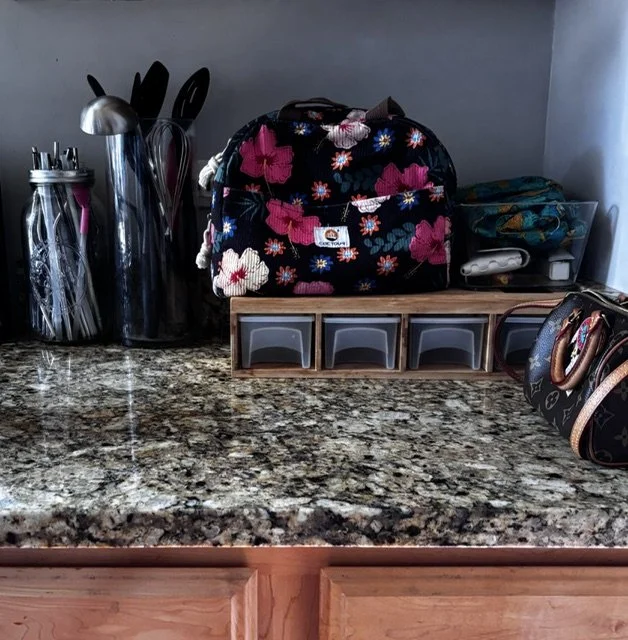
Pictured: My “Catch-All Counter”
This area is clear at the end of each day for a fresh restart the next day.
The Hidden Cost of "Just Doing It Again"
When a space re-clutters, the instinct is often to plan another big organizing session: clear the calendar, pull everything out and start over. That approach can work, but it comes with a hidden cost that's easy to overlook.
Every re-organizing marathon takes time, energy and mental bandwidth that a smaller, consistent system wouldn't require. When that big session inevitably slips (life gets busy, the weekend gets booked, the motivation fades) the space sits in limbo even longer, adding to the quiet mental weight of an unfinished project.
There's also an emotional cost. Each cycle of organizing and re-cluttering can chip away at your confidence, making it feel like the problem is you rather than the system. It isn't. A system that requires a full reset every few months isn't really a maintenance plan, it's just another big project waiting to happen.
The goal isn't to organize harder. It's to organize in a way that requires almost no ongoing effort to sustain.
A Simple Framework for Building a System That Holds
If a space keeps re-cluttering, try asking yourself these four questions.
Does putting things away take fewer steps than leaving them out?
Does every item in this space have one specific home, not just a general area?
Is there a landing zone for the things that enter this space daily?
Am I checking in on this system regularly or only when it's already fallen apart?
If your answers point to extra steps, vague homes, missing landing zones or long stretches without a check-in, that's exactly where the system needs adjusting. None of these fixes require a full weekend. Most take minutes.
You Don't Have to Get It Perfect the First Time
A space re-cluttering isn't proof that organizing doesn't work for you. It's information. It's your home telling you, very specifically, which part of the system doesn't quite fit yet.
Small daily resets, specific homes for every item and a system built around your real habits will hold far longer than a single ambitious overhaul ever could. Progress here isn't about getting it perfect on the first try, it's about noticing what slips and making a small adjustment instead of starting from zero.
At SloanyCo, this is exactly the kind of work we help with, not just clearing a space once, but building a system that's actually built to last. Whether you need help organizing a space for the first time or reworking one that hasn't stuck, we're here for it.
Ready to build a system that actually holds? Visit sloanyco.com to learn more about our services and book your free consultation with SloanyCo today.
